English
 Português
 Español
 Français
When federal prosecutors finally brought down Al Capone, it was not for the murder, extortion, and racketeering that defined his criminal empire. It was for tax evasion. While the charge was real and the conviction legitimate, no serious student of history believes tax evasion told the whole story. It was simply the charge prosecutors believed they could most readily prove.
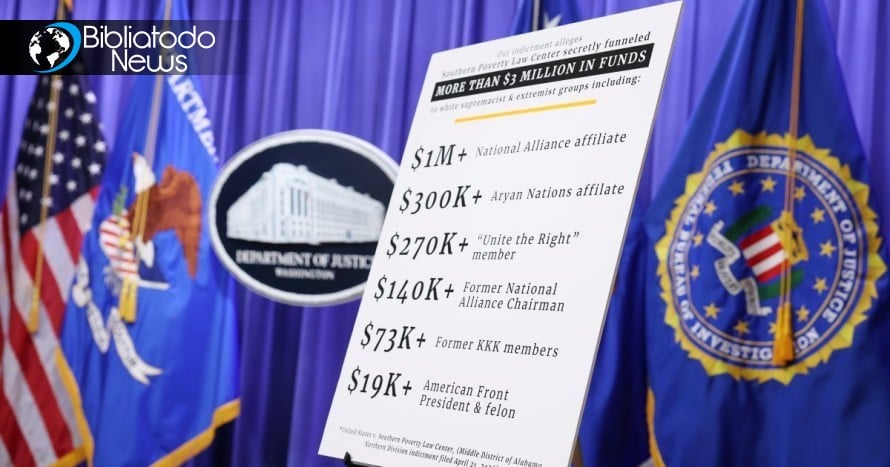
Today, the Southern Poverty Law Center (SPLC) faces a federal indictment on charges of bank fraud, wire fraud, and money laundering.
These charges are serious. But for those familiar with the SPLC’s destructive path, the indictment represents just the tip of the iceberg in what appears to be a much broader system of coordinated influence and institutional coercion.
First, I want to commend the FBI and the Department of Justice for their investigation. I spent considerable time with the FBI, explaining the SPLC’s work and how its influence in the financial world impacted us as a Christian nonprofit.
With the indictment of the SPLC, which has long been the Left’s vanguard in attacking conservative organizations, corporate figures who once deferred to the group are beginning to talk. As a result, we are learning more.
There are several realities we need to understand. Recognizing that traditional hate organizations like the Ku Klux Klan were diminishing, the SPLC adjusted its business model by appointing itself the national arbiter of “hate.” Leveraging its reputation from the civil rights era, it expanded its targets far beyond violent extremist groups.
The first reality is this: although the indictment focuses on a money-raising scheme, the SPLC’s real goal was institutional influence over government, media, and corporate America.
Over time, the SPLC’s “hate” and “extremist” classifications evolved into far more than media narratives. Its labels increasingly became a form of reputational risk assessment used by banks, payment processors, technology companies, financial compliance systems, law enforcement, media, and even parts of the federal government.
The jewel of the SPLC’s operation was its Intelligence Project. It became deeply influential as the government, media, and financial institutions began using its biased data to determine which organizations were acceptable participants in the financial and digital marketplace.
In November 2010, the Family Research Council was among the first wave of Christian organizations placed on the SPLC’s hate map and hate list.
In August 2012, a gunman entered our Washington, D.C., headquarters intending to commit a mass shooting. He shot our building manager before being disarmed. The shooter, Floyd Corkins, carried 100 rounds of ammunition and 15 Chick-fil-A sandwiches, which he planned to stuff into his victims’ mouths. He later confessed to federal agents that he had selected FRC as a target after using the SPLC’s website and hate map.
Unfortunately, that was not the last shooting related to individuals publicly targeted by the SPLC. Other incidents involved then-Republican Whip Steve Scalise (R-La.) in 2017 and Charlie Kirk last year.
Following the shooting at FRC, we appealed to the SPLC to remove organizations like ours from its lists, arguing that its designations had resulted in an act officially deemed domestic terrorism. The SPLC did not respond. It seems clear they did not want to remove the labels because of the institutional influence that had grown around them—the ability to silence the Left’s opponents.
Around 2016, the SPLC led an ad hoc coalition of left-wing activist groups that began pressuring technology companies and financial institutions to deplatform and defund conservative organizations. PayPal was an early target, though initial success was limited.
Then came Charlottesville. This was a catalytic event that rapidly accelerated the SPLC’s efforts to bully corporations.
With that in mind, let me insert information directly from the federal indictment, which identified one of the many extremist group members allegedly funded by the SPLC: an individual identified as F-37. According to the indictment:
Following Charlottesville, major corporations publicly aligned themselves with the SPLC. Apple donated $1 million, and JPMorgan Chase and others followed suit.
Was Charlottesville designed to be a catalytic event to further the SPLC’s efforts to move reluctant corporations?
After Charlottesville, in August 2017, the ad hoc coalition formally organized into what became known as Change the Terms, led by the SPLC and the Center for American Progress. The timeline of Change the Terms closely parallels the rapid acceleration of debanking and deplatforming directed at conservative and Christian organizations. BB&T, now Truist, notified us that, in accordance with our services agreement, they could “at any time, close an account at our discretion.”
It is ironic that, according to the indictment, the SPLC’s own bank allowed it to operate known fraudulent accounts for over a decade.
Change the Terms sought to establish standards for technology and financial companies that would deny digital access and funding to organizations the SPLC deemed extremist. SPLC officials were explicit about this strategy.
In congressional testimony on January 15, 2020, SPLC official Lecia Brooks stated:
“For decades, the SPLC has been fighting hate and exposing how hate groups use the internet. We have lobbied internet companies, one by one, to comply with their own rules to prohibit their services from being used to foster hate or discrimination. A key part of this strategy has been to target these organizations’ funding.”
Brooks went further, openly describing the pressure campaign:
“The public exposure was half the battle. We conducted the other part of the campaign privately. SPLC officials held dozens of meetings with top Silicon Valley executives. Some companies acted. Some took half steps. Others did little or nothing. But eventually, the far-right extremists who depended on Silicon Valley were beginning to feel the pain.”
According to reports, the SPLC appears to have bullied corporations by leveraging its political connections, including regulators. Brooks concluded, “Hate groups have clearly been damaged by the efforts of the SPLC and its allied organizations, including the Change the Terms coalition, to fight them and their funding sources online. But the fight is far from over.”
The fight is indeed far from over. This brings me to the second reality.
The indictment paints a picture that the SPLC was propping up some of the very extremist entities it publicly claimed to be dismantling. The indictment makes clear these were not undercover informants. In some cases, these were individuals allegedly running or helping run operations.
The evidence appears to suggest that these extremist organizations served a larger purpose: providing potent imagery that immediately marginalized legitimate conservative and Christian organizations listed alongside them.
We must be clear: this was not about the SPLC’s financial survival. For anyone tempted to feel sorry for the SPLC, its 2024 audited financial statement shows an endowment fund of approximately $734 million. Nor should anyone assume this indictment marks the end of the SPLC. It has immense resources and reach.
While many financial institutions that partnered with or relied on SPLC classifications since 2017 have begun distancing themselves, the organization still maintains enormous institutional influence. Its school-based program, Learning for Justice (formerly Teaching Tolerance), still reportedly reaches roughly 500,000 educators. Every public school system in America should be asked whether SPLC curriculum materials are being used in its schools.
The SPLC’s public labeling system became far more than a list. Whether by design or evolution, it functioned as a strategic weapon against conservatives. SPLC designations were increasingly used by media organizations to marginalize targeted individuals and groups, while also influencing banking access, digital platforms, fundraising capacity, and public legitimacy.
The indictment may focus on bank fraud and wire fraud. But like Al Capone’s tax evasion case, there is much more beneath the surface: a sophisticated system of influence designed not merely to oppose ideas, but to marginalize and economically punish those who hold them.
The entities that collaborated with the SPLC and caused real harm to individuals and organizations should also be held accountable.
If America is to remain a nation where freedom of speech, religious liberty, and political dissent survive, then the broader network facilitated and directed by the SPLC must be confronted and exposed. Where illegal conduct occurred, those responsible must be held accountable. Just as importantly, safeguards must be established to ensure such a system is never allowed to operate again.